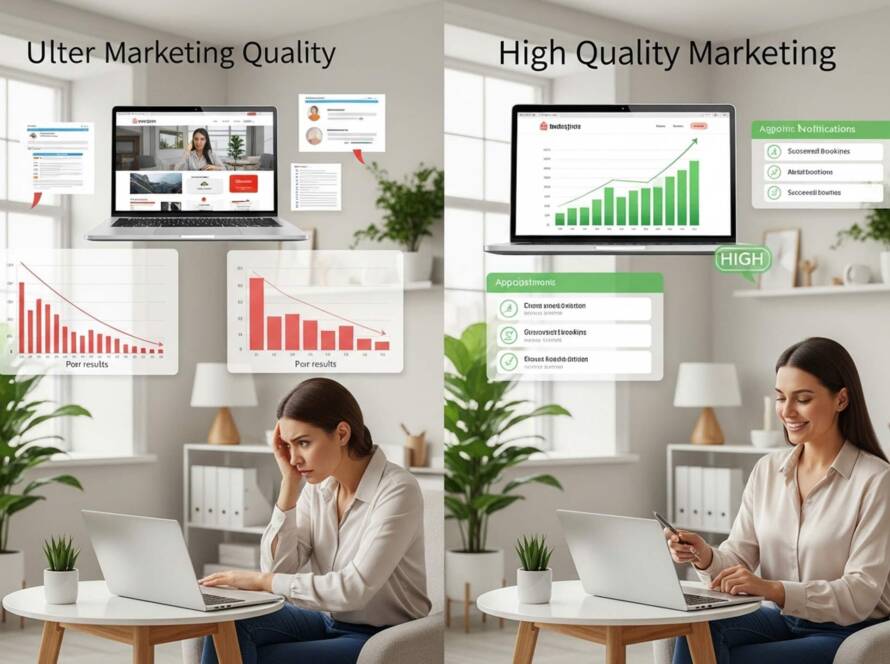
When therapists look at their Google Ads account data, they often assume performance is good because the ads are running and the budget is being spent, but inquiries still don’t come in. Switching up some elements could lead to better results. That’s what Google Ads optimization is meant to do. They want to optimize often because the campaign setups, tests, and adjustments that created optimal performance last month or last week might work against performance today and next week.
Google Ads optimization is the process of continuously refining your campaigns so every dollar spent works harder toward attracting clients who are ready to book. This checklist walks through every area of Google Ads optimization that therapists in private practice need to address, in the right order, with practical steps at each stage.
What is Google Ads?
Google Ads, formerly known as Google AdWords, is a pay-per-click (PPC) platform that allows businesses to gain visibility at the top of Google search results. The most common type of Google Ads is the search ad, which appears on the search engine results page for searches relevant to a therapist’s services, such as “anxiety therapy in Ontario.” You set your budget, choose which keywords you want to target, craft your ads, and only pay when someone clicks. Google Ads offers instant visibility that can’t be achieved as quickly through SEO.
Google Ads optimization is what happens after the campaign launches. It is the process of refining keywords, ad copy, bidding, and landing pages so the campaign delivers a consistent return on your investment.
Why Google Ads Works for Therapists
When someone searches “anxiety therapist near me” or “couples counseling in Mississauga,” they are not just browsing. They are ready to book an appointment. That is the main advantage of search advertising over social media or directories. It offers targeted, cost-effective, and trackable marketing for therapists, so they can reach specific audiences and locations.
- Targets High-Intent Clients: Unlike social media ads, Google Ads appear when people are searching for specific services like “anxiety therapist near me,” targeting individuals ready to book.
- Cost-Efficient: Therapists pay only when someone clicks the ad, allowing accurate tracking of how much it costs to acquire a new client.
- Specific Targeting: Ads can be tailored to specific specializations (e.g., trauma therapy) and local areas (e.g., couples counselling in Ontario), ensuring relevant traffic.
- Builds Trust and Visibility: Appearing at the top of Google searches increases trust and professional visibility.
- Immediate Results: Unlike SEO, which takes months to generate results, Google Ads can help bookings almost instantly
Understanding top online advertising platforms for therapists helps clarify where Google Ads fits, and pairing that knowledge with other marketing strategies helps grow your practice.
Before You Optimize: Get the Foundation Right
Google Ads optimization only works when the foundation underneath it is solid. Before touching bids or keywords, confirm these fundamentals are in place.
Conversion Tracking Is Set Up Correctly: Before you optimize anything, you need to know if your data tells the truth. Every optimization decision downstream depends on accurate data. If your conversion tracking does not align with your actual business results, you are optimizing toward the wrong goals.
For therapists, a conversion is typically a contact form submission, a phone call, or a booking page visit. Set up each of these as a separate conversion action in Google Ads.
Your Website Is Ready to Convert: Sending paid traffic to a slow, unclear, or poorly designed website wastes every dollar spent on clicks. Professional web design for therapists should communicate trust, clarity, and a clear next step before any paid traffic arrives.
Your Goal Is Defined: Know what a converted client is worth to your practice before setting a budget. This determines what you can afford to pay per click and per lead without losing money on the campaign.
Keyword Optimization
Keywords determine who sees your ads. Getting this right is the single most important factor in Google Ads optimization for therapists.
Use Specific, Intent-Based Keywords
Google Ads keyword optimization begins with a comprehensive understanding of search intent and how potential clients discover your services. Keyword relevance, match type selection, negative keyword implementation, and Quality Score improvement form the core pillars of any successful optimization strategy.
For therapists, the highest-converting keywords combine a specialty with a location: “anxiety therapist Toronto,” “trauma counseling near me,” “EMDR therapy Mississauga.”
Add Negative Keywords Weekly
Reviewing search terms weekly and adding negative keywords consistently has a compounding effect on campaign performance. The more you clean up your traffic, the better your click-through rates get and the more traffic you convert into leads.
Common negative keywords for therapists include “free therapy,” “therapy jobs,” “therapy training,” and “DIY mental health.” These terms attract clicks that will never convert into paying clients.
Organise Keywords by Theme
Rather than grouping unrelated keywords together, organise ad groups around specific themes. Thematic ad groups with closely related keywords offer better scalability while maintaining relevance.
Each specialty you offer should have its own ad group: anxiety, depression, couples counseling, and trauma. This allows you to write ad copy that speaks directly to what each searcher is looking for.
Review Match Types
Broad match can generate irrelevant traffic quickly. Start with phrase match and exact match for tighter control over who sees your ads. Expand to broader match types only after you have enough conversion data to guide Google’s algorithm.
Ad Copy Optimization
Your ad is the first impression a potential client has of your practice. It needs to speak directly to what they are searching for.
Lead With the Problem, Not Your Credentials
Someone searching for an anxiety therapist is thinking about how they feel, not about your certifications. Write headlines that reflect their experience: “Struggling With Anxiety?” performs better than “Licensed Anxiety Therapist Available.”
Include Your Location
Local searches dominate therapy-related queries. Including your city or neighborhood in the headline and description increases relevance and click-through rates significantly.
Test Multiple Ad Variations
A/B testing helps identify what works best and refines campaigns accordingly. Test one element at a time: the headline, the call to action, or the description. Changing multiple elements simultaneously makes it impossible to know what drove the change in performance.
Run at least two ad variations per ad group at all times. Let data accumulate over two to four weeks before making a judgment on which performs better.
Use Ad Extensions
Ad extensions such as site links, callouts, and structured snippets offer more information and improve ad visibility. For therapists, useful extensions include a phone number, a link to your booking page, and callouts highlighting key features like “Accepting New Clients” or “Virtual Sessions Available.”
Landing Page Optimization
The landing page is where clicks either convert into enquiries or disappear. Most therapy practices send Google Ads traffic to their homepage. This is one of the most common and costly mistakes in Google Ads optimization.
Match the Landing Page to the Ad
If someone clicks an ad for anxiety therapy, they should land on a page specifically about anxiety therapy, not your general homepage. The more closely the page matches the search intent, the higher the conversion rate.
Keep the Page Focused
A landing page for paid traffic should have one job: get the visitor to take the next step. Remove navigation menus, unrelated service descriptions, and anything that pulls attention away from the booking or contact action.
Make the Call to Action Clear
“Book a Free Consultation,” “Call Us Today,” or “Request an Appointment” should appear prominently above the fold and be repeated further down the page. Do not make visitors hunt for how to reach you.
Optimise for Mobile
If the mobile version of a landing page is converting poorly, simple tweaks to the mobile layout can dramatically improve conversion rates. Same traffic, same ads, same budget — just a better mobile experience produces significantly better results.
Check your landing page on multiple mobile devices before running any paid campaign.
Bidding and Budget Optimization
Start With Manual Bidding
New campaigns do not have enough data for Google’s automated bidding strategies to work effectively. Start with manual cost-per-click bidding to gather data before transitioning to automated strategies.
Transition to Smart Bidding When Ready
Automating your bidding to Target CPA or Target ROAS provides better cost predictability and a better return on investment for campaigns with enough data. Even with automated bidding, we need to monitor CPC, conversion rate, and impression share daily. Target CPA is the most feasible automated bid strategy for most therapy practices with at least 30 conversions in the past 30 days.
Adjust Bids by Device and Time
Boost bids on mobile if it has a higher conversion rate than desktop. Increase bids in high-converting locations or hours. Automated bidding combined with adjustments such as device, location, or schedule optimizes performance while saving money. Review your hourly and daily performance data. Evening hours normally generate the most enquiries for therapy.
Set a Realistic Daily Budget
Calculate how many clicks you are required in a day to generate one enquiry based on your conversion rate. Multiply that by the average cost per click. This will provide you with a minimum daily budget that can actually produce results.
Audience and Targeting Optimization
Use Location Targeting Precisely
Target the specific cities, neighbourhoods, or radius around your practice location. Avoid broad regional targeting that includes areas too far for clients to realistically travel.
Layer Audience Signals
Advanced audience targeting focuses on refined audience segments based on behaviour, intent, and demographics. This approach allows ads to reach people who are more likely to convert rather than just browse.
In Google Ads, you can layer audiences such as “people who have visited your website” or “people with interests in mental health” on top of your keyword targeting. These layers improve efficiency without reducing reach significantly.
Use Remarketing
Remarketing targets ads to users who previously visited your website but did not convert. Someone who visited your anxiety therapy page but did not fill out the contact form is a warm lead. A remarketing ad that appears as they browse other websites keeps your practice visible and prompts them to return.
Tracking and Conversion Setup
Track Every Meaningful Action
Set up separate conversion tracking for phone calls, form submissions, and booking page visits. Tracking only one action gives you an incomplete picture of how your ads are performing.
Connect Google Ads to Google Analytics
Linking both platforms gives you visibility into what happens after someone clicks your ad — which pages they visit, how long they stay, and where they drop off. This data improves every other area of Google Ads optimization.
Review Your Attribution Model
Accurate and consistent conversion tracking leads to data-driven decisions. Using different attribution models affects how credit is assigned to clicks in the conversion path, which changes how you evaluate campaign performance.
For therapists with longer consideration periods, a data-driven or time-decay attribution model gives a more accurate picture of which ads are actually contributing to new client enquiries.
How Often Should You Optimize?
Google Ads optimization is time-based. Some tasks should be done daily, some weekly, some monthly, and some quarterly. Applying optimizations on a consistent schedule and watching performance over time is what produces sustainable improvement.
Daily: Check for budget pacing issues and any sudden drops in impressions or conversions.
Weekly: Review search term reports and add negative keywords. Check click-through rates and conversion rates across ad groups.
Monthly: Review keyword performance and pause underperformers. Test new ad copy. Assess landing page conversion rates. Adjust bids based on performance data.
Quarterly: Review overall campaign structure. Assess whether your targeting still matches your ideal client profile. Evaluate ROI against your cost per client acquisition.
Google Ads Optimization Checklist at a Glance
Area | Task | Frequency |
Conversion Tracking | Verify all actions are tracking correctly | Monthly |
Keywords | Review search terms and add negatives | Weekly |
Keywords | Pause underperforming keywords | Monthly |
Ad Copy | Test new headline or description variation | Monthly |
Ad Extensions | Check all extensions are active and relevant | Monthly |
Landing Page | Check mobile load speed and conversion rate | Monthly |
Bidding | Review CPC and adjust for device and time | Weekly |
Audiences | Add remarketing lists to active campaigns | Quarterly |
Budget | Confirm daily budget matches conversion goals | Monthly |
Analytics | Review post-click behaviour in Google Analytics | Monthly |
Conclusion
Google Ads optimization is not a one-time task. It is a discipline that compounds over time, with each small improvement building on the last. For therapists in private practice, a well-optimized campaign is one of the most direct paths to a consistently full caseload.
Whether your practice is building its first campaign or refining an existing one, Psychotherapy Growth is here to help every step of the way. Start with the checklist, work through each area systematically, and let the data guide every decision from there.
FAQs
Google Ads optimization involves continuously refining your keywords, ad copy, bidding, and landing pages to increase conversions. This means tracking your Google Ads account to make necessary adjustments to attract more clients.
This is most likely a disconnect between the searcher’s issue and your headline. To boost engagement, try refining your ad copy to address their particular problem; this is an important element of Google Ads optimization.
Lead costs vary by city, but a well-managed campaign typically aims for a cost-per-inquiry that is a fraction of a single session’s fee. Ongoing Google Ads optimization helps lower this cost over time by improving your Quality Score.
Improving your return involves more than just bidding; it requires a systematic approach to refining search terms, testing ad headlines, and ensuring your web design is specifically tailored to turn visitors into booked consultations.
Success is measured through end-to-end conversion tracking. By linking your ads to form completions and phone calls, you can see exactly which keywords resulted in a consultation, allowing you to focus on what works.