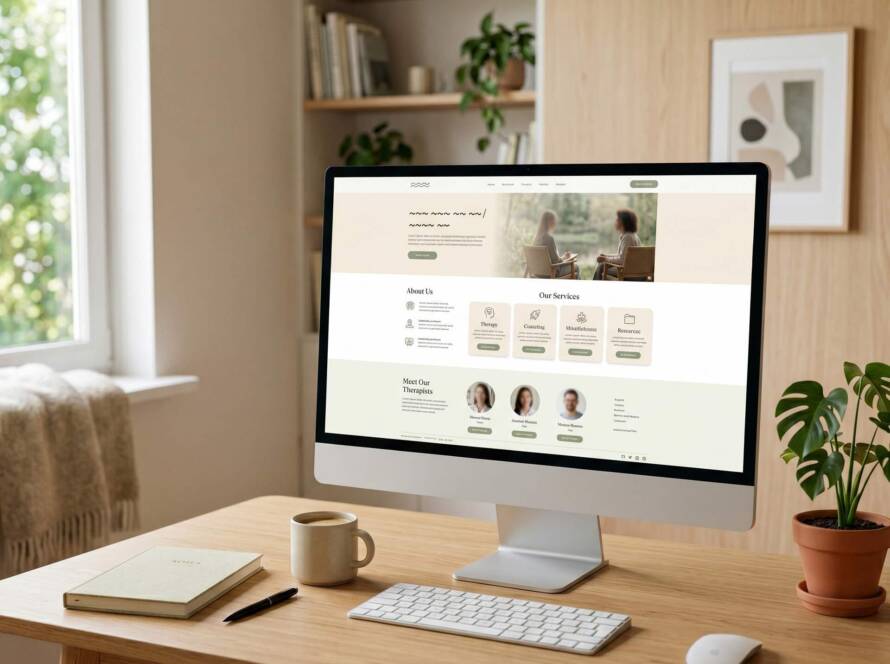
“This is your most valuable member of the team, because he or she does not sleep, does not have vacations, and does all the preliminary work when it comes to your business”. In 2026, over 80% of individuals who are looking for therapists start their searches online. As such, making sure that your website gives off the right impression will influence a lot whether an individual becomes your client or not in mere seconds. Today, mental health website features are not additional options but something that can make a practice sustainable and prosperous in 2026.
What Are Mental Health Website Features?
Website features for mental health are the actual attributes that have been designed in the website of the therapist for the purpose of attracting and converting prospective customers. Website features go past just a simple contact page. They work in combination to convey a professional image, build credibility, enhance accessibility, and ultimately move a visitor to book their first appointment with you. In 2026, even Google evaluates websites in terms of user experience factors like page load time and content structure, hence they benefit you as well as your clients.
Why Your Website Design Directly Affects Client Growth
It is typical for practitioners to focus more on their skills in practice rather than on their digital marketing. This is an expensive mistake. According to research by Stanford University, 75% of consumers form an impression about the credibility of a company simply based on the look of its site. In the case of psychological practitioners, since credibility is what matters most in their practice, poor web design may be disastrous for them.
A well-structured website, paired with the right digital marketing strategies for therapists, creates a complete growth system. When your website features are aligned with how clients search and decide, your practice grows with far less manual effort.
Core Mental Health Website Features Every Therapist Needs
1. Online Booking and Scheduling
A client in 2026 will want to book an appointment the same way he or she books dinner or a ride: instantly, without even picking up a phone. The inclusion of one scheduling program gets rid of what is commonly regarded as the biggest barrier on a therapist’s web page. JaneApp and SimplePractice, for example, offer a chance to integrate a scheduler into a therapist’s website. One function like that increases the number of inquiries by over 30%.
2. Mobile-Responsive Design
More than 68% of all internet traffic by 2026 is from mobile devices. Your website will miss out on more than two-thirds of its possible visitors if it is not mobile-friendly, before even having a chance to read your biography. The mobile-friendly website layout automatically scales down its format, font size, and navigation menu according to the device’s screen size. Google is implementing a mobile-first index, where your mobile site impacts your ranking on Google. This is one of the most crucial mental health website features.
3. Clear and Specialized Service Pages
Potential clients must understand in five seconds what your services are about and who your target audience is. Generic descriptions such as “I am helping people to get better” are no longer converting. Every type of service that you provide should have its own page describing in detail the service provided, who the target client is, and the process involved. This will also be beneficial for your website SEO. If you want to attract the right clients, brand building for your therapy practice starts with being specific on every page of your website.
4. Trust Signals and Social Proof
Potential new clients will be making a personal decision when they contact a therapist. As such, their fears need to be addressed immediately upon arriving on your website. These trust factors include displaying your picture, certifications, license, testimonials, media appearances, and association with any professional body. Having an “As Seen On” section or an introduction by the therapist could significantly boost the conversion rates of your website traffic into inquiries.
5. HIPAA/PIPEDA-Compliant Contact Forms
A default contact form for WordPress will not do for a psychotherapy practice. All forms capturing any type of client data should be encrypted and HIPAA compliant if you’re in the United States, or PIPEDA and PHIPA compliant if you’re in Canada. Using an unencrypted or non-HIPAA-compliant form can expose you to liability and also send a message to privacy-sensitive clients that you don’t take their data seriously.
6. Live Chat or Chatbot Support
For many seeking therapy, it is unlikely that they will dial their phone number or even email them. The presence of a live chat function or a carefully programmed chatbot can be very helpful here. By 2026, an AI-enabled chatbot will be able to give answers to many standard questions regarding their services, cost, insurance coverage, and availability throughout the day. It guarantees that a person who comes online late at night and thinks that they need help receives a reply straight away.
7. Blog and Resource Section
Updating your blog regularly will serve a dual purpose by both demonstrating your clinical competence and enhancing your website’s SEO. Websites that frequently offer valuable content receive an advantage from Google. Blogs that aim to answer queries made on Google by your target clients, such as “how to cope with work-related anxiety” or “symptoms indicating the need for therapy,” bring in traffic with intent and hence convert very well. This is exactly the kind of content marketing for therapists strategy that compounds in value over time.
Advanced Features That Separate Growing Practices
Beyond the core features, several advanced additions can give a therapy website a significant edge in a competitive market.
Telehealth Integration: Embedding a live telehealth session through a link within your website will offer a more seamless process and lower no-shows. Popular platforms such as Doxy.me work seamlessly with the vast majority of websites.
Multilingual Support: In a country where many urban environments are diverse in terms of population, supporting two or more languages on your website will significantly expand your audience. Therapists who cater to certain cultural groups can benefit from this.
Accessibility Features: Descriptive alternate text for all images, easy navigation via keyboard shortcuts, and high-contrast colors should be considered part of good website design, as these features help rank higher on Google’s accessibility checklist.
Client Portal Integration: Your current clients should have access to session summaries, intake forms, and invoices directly on your website without having to log into an external platform.
Understanding which online platform for therapists to use alongside these features helps ensure your website and your practice management system work together rather than against each other.
Mental Health Website Features Comparison Table
Feature | Impact on SEO | Impact on Conversions | Difficulty in Implementing |
Online Booking | Medium | Very High | Low |
Mobile-Responsive Design | Very High | High | Low |
Specialized Service Pages | Very High | High | Medium |
Trust Signals | Low | Very High | Low |
Compliant Contact Forms | Low | High | Medium |
Live Chat / Chatbot | Low | High | Medium |
Blog and Resources | Very High | Medium | Medium |
Telehealth Integration | Medium | High | Medium |
Multilingual Support | High | Medium | High |
Client Portal | Low | High | High |
How to Prioritize Features Based on Your Practice Stage
Not every therapist needs to build every feature at once. Here is a practical framework for 2026.
Stage 1 (New Practice): Start with a mobile-responsive design, one or two clear service pages, a compliant contact form, and a basic blog. These give you a credible online presence and a foundation for SEO.
Stage 2 (Growing Practice): Add online booking, trust signals, live chat, and expand your service pages. Start tracking conversion data through Google Analytics 4 to understand where visitors are dropping off.
Stage 3 (Established Practice): Layer in telehealth integration, a client portal, multilingual support, and an active content strategy. At this stage, pairing your website with SEO for therapists becomes the primary growth lever to increase visibility and reduce reliance on paid referrals.
Conclusion
The therapy website in 2026 will no longer be just an online business card. In fact, it should represent the client-acquisition system and the quality of services you provide to potential customers. The correct implementation of mental health website features will help diminish the barrier that stands between the person experiencing problems and the help he or she needs. If it’s the first time you build a website or review its effectiveness, start by choosing the features that would work best for your clients, not Google Search.
If you are ready to build a website that actually grows your practice, visit Psychotherapy Growth to explore how our team helps therapists turn their websites into their most powerful marketing asset.
FAQs
The most important mental health website features are mobile-responsive design, online booking, clear service pages, and trust signals like credentials and testimonials.
Features like mobile optimization, fast load speed, structured service pages, and a consistent blog directly influence SEO and help your site rank for local therapy searches.
Yes. Any form or tool that collects client health information must comply with HIPAA (U.S.) or PIPEDA and PHIPA (Canada). Non-compliant tools put your practice at legal and reputational risk.
Review your website quarterly, publish blog posts at least twice a month, and update service pages annually to stay current and maintain strong SEO performance.
WordPress offers the most flexibility for SEO and content. Squarespace and Wix are easier to set up but more limited. Whichever you choose, make sure it supports all core mental health website features, including compliant forms and mobile optimization.